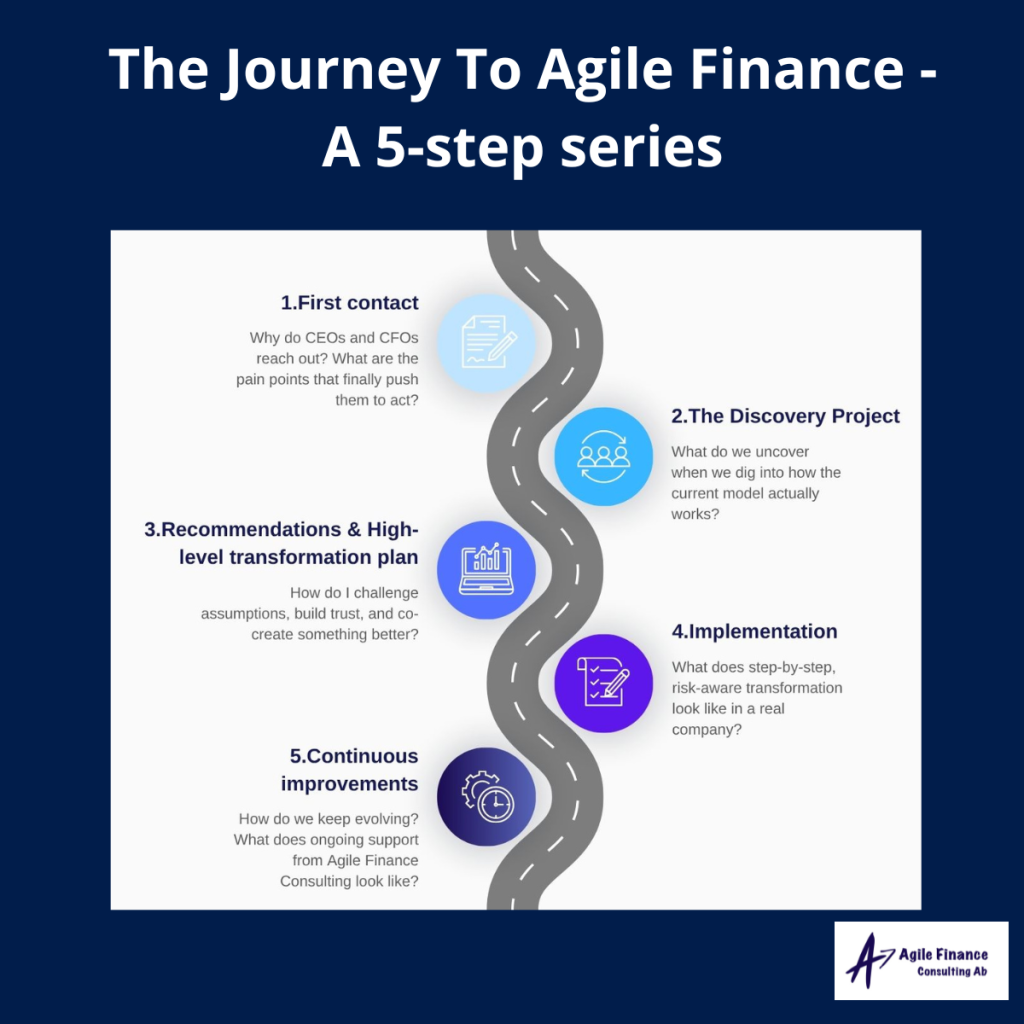
1. First Contact – The Moment Something Breaks
It often starts with a short message:
“Hi Daniela, we’ve been talking internally about our budgeting process…”
Behind that message is a realization: The current way of planning doesn’t fit how the business operates today.
 Leadership wants to move faster, align better, and empower teams — but finance is a bottleneck.
Whether it’s the CEO, CFO, or controller reaching out, they’re often looking for:
– A planning model that can handle change
– Financial processes that support real collaboration
– A way to get out of Excel chaos without losing control
2. The Discovery Project – From Insight To Direction
We start by building a shared understanding of what agile finance really means — and what it could look like here.
Then we dig into how things actually work today:
- Budget cycles, forecasting, target setting, activity planning, reporting, analytics, roles, tools, pain points, workarounds
Next, we apply an agility lens:
- Where is the organization flexible?
- Where is it stuck?
- How fast can it respond to change?
We define a future state – a realistic vision of what good could look like.
And we connect the dots with a simple gap analysis:
 What needs to shift in mindset, structure, and behavior?
This phase builds insight, shared language, and direction.
Before we change anything, we know why — and where we’re going.
3. Recommendations & High-level implementation plan – Co-Creating the Future (and Challenging Assumptions)
Next comes the pivotal moment: What should change, when and how?
I always tailor my recommendations to the business context. But they usually include shifts in:
– Planning rhythm – moving from annual to rolling
– Team autonomy – clearer ownership and accountability
– Decision making and analytics – more dynamic and aligned with business needs
– Systems and tools – enabling fast and recurrent planning and forecasting
I guide, listen, and challenge. The best results happen when finance leads the shift, not just follows it.
4. Implementation – Step by Step, with the Right Support
Agile finance is not a “plug-and-play” solution. It’s a mindset shift, and a design project.
Together, we implement in steps and learn and evaluate after each step:
- Low hanging fruits – small changes with big effect
- Bigger changes – start small and test
- Communicate, communicate, communicate
- Coaching leadership and controllers
- Adjusting system support as needed
Some clients want close facilitation or even hands-on help. Others prefer occasional coaching. Either way, the change sticks because it’s grounded in real needs and ownership.
5. Continuous Improvements – Keeping Finance Adaptive
Once the new way of working is in place, the real journey begins.
To stay agile in finance the mindset, ways of working and needs to constantly be reviewed and adjusted to support the constant changes to the business.
With regular internal reviews clients evaluate:
– What’s working?
– What’s become a new bottleneck?
– Where can we push further?
Some clients continue partnering with me regarding:
– Quarterly check-ins
– Retrospectives on financial decision-making
– CFO coaching
Agility in finance isn’t a destination — it’s a capability to evolve.
Final Thoughts: Why This Journey Matters
Shifting to agile finance is not about replacing your current tools. It’s about upgrading your leadership operating system — one that helps your company:
– Move faster
– Plan smarter
– Collaborate better
– Stay in control without controlling everything
It’s one of the most strategic shifts a mid-sized company can make.